
Middle Grades Education Overview: National Louis University
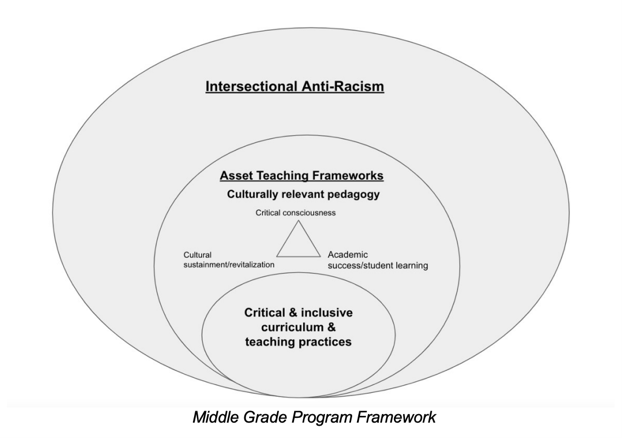
The M.A.T. Middle Grades (MGE) program at National Louis University’s National College of Education prepares educators who embrace the vibrancy and unique needs of young adolescents. Built on the AMLE teacher preparation standards and Illinois Culturally Relevant Teaching and Leading Standards, our program champions an intersectional, anti-racist, and anti-adultist approach to teacher preparation education. At its core, we focus on addressing educational debts owed to minoritized students while honoring the layered identities of students and their families.
Our curriculum critically examines both historical educational practices and transformative possibilities for young adolescents and their families. The program’s theoretical foundation emphasizes the importance of disrupting traditional power dynamics in education by constantly positioning students as knowledge-bearers and active participants in their learning journey. This approach manifests through three key principles: listening to student voices, responding to student-identified needs, and collaborating with young adolescents as partners in their educational journey.
From their first courses, candidates learn to challenge traditional teaching approaches through structured engagement with student perspectives. Our program features multiple opportunities for candidates to center student voices and experiences:
- Candidates conduct comprehensive ‘shadow studies’ where they observe middle school students across multiple class settings. Through semi-structured student interviews, candidates learn directly from young adolescents about the impact of different teaching approaches, using AMLE’s “The Successful Middle School” principles as a framework for analysis. This firsthand student feedback drives candidates’ understanding of effective middle grades practice.
- In developing Project-Based Learning (PBL) units, candidates begin with student interviews to understand learners’ interests, concerns, and aspirations. These conversations shape the creation of interdisciplinary materials that incorporate Universal Design for Learning (UDL) approaches and civic engagement while meeting content standards. Student voice thus becomes the foundation for curriculum design.
- Candidates analyze their placement school’s 5Essentials survey data alongside interviews with parents, teachers, and students. This multi-stakeholder approach, centered on student and community perspectives, helps candidates identify and build upon community assets while addressing articulated needs.
The program’s commitment to identity work and bias examination is grounded in critical pedagogy and culturally relevant teaching. That the program remains relatively small, with few more than 60 students enrolled in classes each year, allows faculty to successfully execute deeply personal and individualized assignments. One such assignment is the “personal syllabus,” where candidates engage with historically marginalized perspectives and practice responsive listening. The transformative power of this work is evident in our candidates’ reflections. After studying LGBTQ+ youth experiences, one candidate shared: “This process has impacted my understanding to see and process things from another person’s perspective. I, too, was blinded with homophobia and stereotypes towards this community… What I have learned moving forward in my life is first to reflect and trust others’ experiences.”
We acknowledge that school realities may differ from university ideals. During student teaching, faculty support candidates in creating graduated zones of influence—starting with individual students and building toward full inquiry-based units. All lesson plans must explicitly address culturally responsive teaching principles, with student background/experience/responses serving as integral evidence for instructional decisions. To further bridge theory and practice, our close partnership with the Association of Illinois Middle Schools (AIMS) connects candidates with a network of exemplary middle grades educators and schools, providing ongoing professional development through conferences and school visits throughout their preparation.
As MGE faculty member Brian Morris explains, “Candidates work tirelessly to understand self and the impact that our identity intersections have on all decisions, especially those that influence instruction… This marriage of theory and practice in a brave, supportive space allows candidates to make mistakes, be vulnerable, and refine their practice, all while becoming better humans.”
The program’s effectiveness in preparing equity-focused educators is evident in our graduates’ reflections. As one alumnus shares: “I can’t talk about the MGE program without discussing the focus on social justice issues. It’s allowed me to begin the process of reckoning with my own implicit biases, which is an ongoing process. It’s so important to have this mindset when going into increasingly diverse middle school classrooms.”
Middle Grades NLU Faculty
- Dr. Hannah Graham, Associate Professor and Program Chair, MGE
- Professor Brian Morris, Associate Director – Field Supervision, Residencies & DEI Strategy
- Dr. Vishodana Thamotharan, Assistant Professor and Director of STEM, NCE
- Professor Keviyona Smith Ray, MGE Faculty and Chicago Public Schools Principal
- Professor Chris Latting, MGE Faculty, D65 Principal, and Golden Apple Leadership Finalist
- Professor Gina Harris, MGE Faculty and Illinois Education Association Executive Committee